

A 20ft shipping container is the shorter of the two everyday container lengths. On the outside it is 20 feet long (19′ 10.5″ exactly), 8 feet wide and 8′ 6″ tall, with about 33 cubic meters (1,170 cubic feet) of space inside. Buyers choose it when site space is tight, when the cargo is heavy for its size, or when a 40ft is more box than the job needs.
Buying 20ft containers for resale, a job site or a fleet? Request a wholesale quote or call (888) 471-9099.
20ft shipping container specs at a glance
Outside sizes follow the ISO 668 standard. Inside and door sizes vary a little by builder. The figures below come from Lummid’s equipment specification sheet (Excel file) for a standard 20ft steel container.
| Spec | Metric | Imperial |
|---|---|---|
| Outside (L x W x H) | 6,058 x 2,438 x 2,591 mm | 19′ 10.5″ x 8′ x 8′ 6″ |
| Inside (L x W x H) | 5,898 x 2,352 x 2,391 mm | 19′ 4.2″ x 7′ 8.6″ x 7′ 10″ |
| Door opening (W x H) | 2,340 x 2,280 mm | 7′ 8″ x 7′ 5.8″ |
| Tare (empty weight) | 2,280 kg | 5,030 lb |
| Max gross (two ratings listed) | 24,000 or 30,480 kg | 52,910 or 67,200 lb |
| Max payload | 21,720 or 28,200 kg | 47,880 or 62,170 lb |
| Inside volume | 33.2 cubic meters | 1,171 cubic feet |
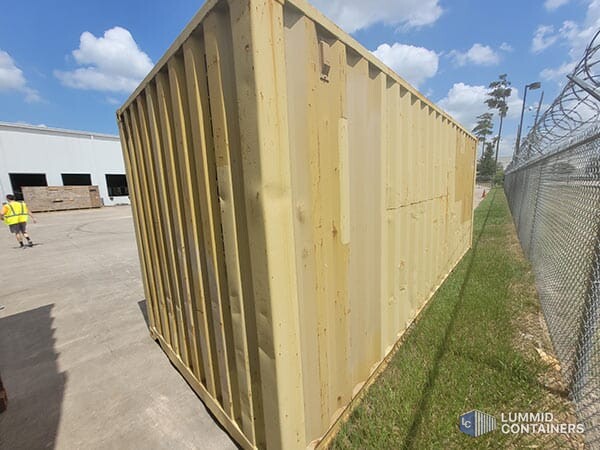
The sheet lists two max gross ratings because ratings differ between builds. Every unit carries its own numbers on its CSC plate and door markings, and those are the ones that count. The new green 20ft at the top of this page is marked 22G1, max gross 30,480 kg (67,200 lb), tare 2,000 kg (4,410 lb), payload 28,480 kg (62,790 lb) and 33.1 cubic meters.
20ft standard vs 20ft high cube
A 20ft high cube (20HC) has the same length and width as a standard 20ft but stands 9′ 6″ tall instead of 8′ 6″. The code on the doors tells them apart. In the BIC system the first character is the length (2 means 20 feet) and the second is the height (2 means 8′ 6″, 5 means 9′ 6″ high cube), and G1 means general purpose. So a standard 20 reads 22G1 and a high cube 20 reads 25G1.
The extra foot carries through inside and at the door, which helps with tall pallets, shelving and office builds.
20HC units are generally sold new (one trip) only. As the Lummid specialty equipment page explains, shipping lines and leasing companies do not use them, so very few used 20HCs exist. If you want 40ft high cube height in a 20ft footprint, plan on buying new.
When a 20ft makes more sense than a 40ft
- Tight sites. At half the length of a 40ft, a 20ft fits narrow yards, job sites and gaps between buildings, and needs less room to set down.
- Heavy, dense cargo. A 20ft can carry as much weight as a 40ft: Lummid’s spec sheet lists up to 28,200 kg of payload for a 20ft against 26,650 kg for a 40ft standard, in half the floor space.
20ft container grades for wholesale buyers
Wholesalers grade containers on structure, not looks, so a lower grade box can sometimes look better than a higher grade one. Grades you will see on a wholesale quote:
- New (one trip). Built and shipped once with cargo, usually 3 months to a year old. Even new boxes can have minor scuffs inside and out from forklifts, trucks and ships.
- IICL. A used grade named after the Institute of International Container Lessors standards. An IICL box should also pass a cargo worthy certification, but may not come with an updated certificate or ACEP sticker.
- Cargo worthy (CW). Structurally fit to ship cargo. Like every container it has a CSC plate, and it qualifies for recertification by a certified inspector, whose ACEP sticker lets it ship cargo again for a set period. For boxes in shipping service, U.S. rules (49 CFR 452) require a first examination within five years of manufacture, then at least every 30 months, unless the owner runs an approved continuous examination program.
- Wind and watertight (WWT). Keeps the weather out but may fail a cargo worthy inspection, for example over a weakened floor or a bent crossmember that would cost too much to repair. Often a perfect storage box. Simple test: stand inside with the doors closed and look for light.
- As is or damaged. Sold without a structural promise. Damaged boxes can have holes, bent frames, bad doors or damaged floors.
Used containers are typically 10 to 20 years old when sold. Surface rust is normal on Corten steel; what matters is rust that has gone through or can be knocked through. A repair does not change a box’s grade, and CW and WWT often sell for about the same price, so take CW when it is available. Lummid also sells refurbished used 20s: steel brushed, repainted in your color, joints and door hinges greased. Our IICL, WWT and cargo worthy guide covers each grade.
How wholesale buying works
Wholesale 20s are sold from stacks at container depots, which work like warehouses. Unlike at a local retailer, buyers cannot walk the yard and pick a box. What to expect:
- Pickup. Most wholesale customers pick up at the depot themselves, using a release order. Our release orders guide explains how that works.
- Check at pickup. Look the box over before it leaves the depot and call the wholesaler right then if something is wrong; often a different unit can be loaded on the spot. Once you leave with a container, you have accepted it. If you find damage at delivery, report it right away with photos.
- If a box misses its grade. When a missed repair or damage puts a unit outside the grade you bought, most wholesalers, Lummid included, pay the estimated repair cost. Dings, dents, scratches and scuffs within IICL guidelines do not count.
- Delivery. Wholesalers generally do not do last-mile delivery. Lummid can put you in touch with local drivers or schedule delivery for you.
- Tax and payment. Wholesalers do not charge sales tax, but they need a copy of your resale tax certificate. Most do not take credit cards; wire, ACH, check or direct deposit are the norm.
What to confirm when you order
- Size and height: standard 20ft (8′ 6″) or 20ft high cube (9′ 6″).
- Grade: one trip, IICL, cargo worthy, wind and watertight, as is, or refurbished in your color.
- Quantity and pickup city: see where Lummid has equipment.
- Doors: standard end doors or one of the layouts below.
- Pickup or delivery: your own trucker, or help lining up a local driver.
- Paperwork: your resale tax certificate if you resell, and how you will pay.
Other 20ft options
Lummid’s containers page and specialty page also list these 20ft variations:
- Open top and flat rack 20ft units, new or used.
- Open side 20ft and 20HC units, with a full open side or a 2-door open side.
- Double door (tunnel) 20ft and 20HC units, with cargo doors on both ends.
- Mobile offices built on 20ft and 20HC units, insulated, with electrical, windows and doors.
- Nested 20HC sets: a 20HC holding two 9ft, two 8ft and two 7ft containers, seven containers in one.
- Custom builds to your specifications, built to order.
Lummid also does full factory modifications on units it builds and ships from Asia, and local modifications in some markets.
FAQ
How big is a 20ft shipping container inside?
A standard 20ft is about 19′ 4″ long, 7′ 8″ wide and 7′ 10″ tall inside, roughly 33 cubic meters, with a door opening about 7′ 8″ wide and just under 7′ 6″ tall. Exact figures vary slightly by builder.
How much weight can a 20ft container carry?
Subtract the tare from the max gross printed on the doors. Many 20s are rated at 30,480 kg (67,200 lb) max gross, which leaves about 28,000 kg (62,000 lb) of payload. On U.S. roads there is a second limit: on the Interstate system a truck is generally capped at 80,000 lb gross vehicle weight, counting the tractor, chassis, container and cargo together. Check with your trucker before loading a 20 near its rating.
Can I buy a used 20ft high cube?
Rarely. 20HCs are generally sold new (one trip) only, since shipping lines and leasing companies do not use them. Ask for current availability.
Get a quote
Need 20ft containers for your yard, a job site or your own resale stock? Request a wholesale quote or call (888) 471-9099. Tell us the size, grade, quantity and pickup city. Only need one box? Send us your city and state and we will help you find a trusted retailer near you.
Sources
- ISO 668:2020, Series 1 freight containers: Classification, dimensions and ratings
- BIC: Size type code (ISO 6346 length and height codes)
- BIC: The CSC combined data plate explained
- IMO: International Convention for Safe Containers (CSC)
- 49 CFR 452.1: Periodic examination required (Cornell LII)
- 23 CFR 658.17: Weight (Cornell LII)