
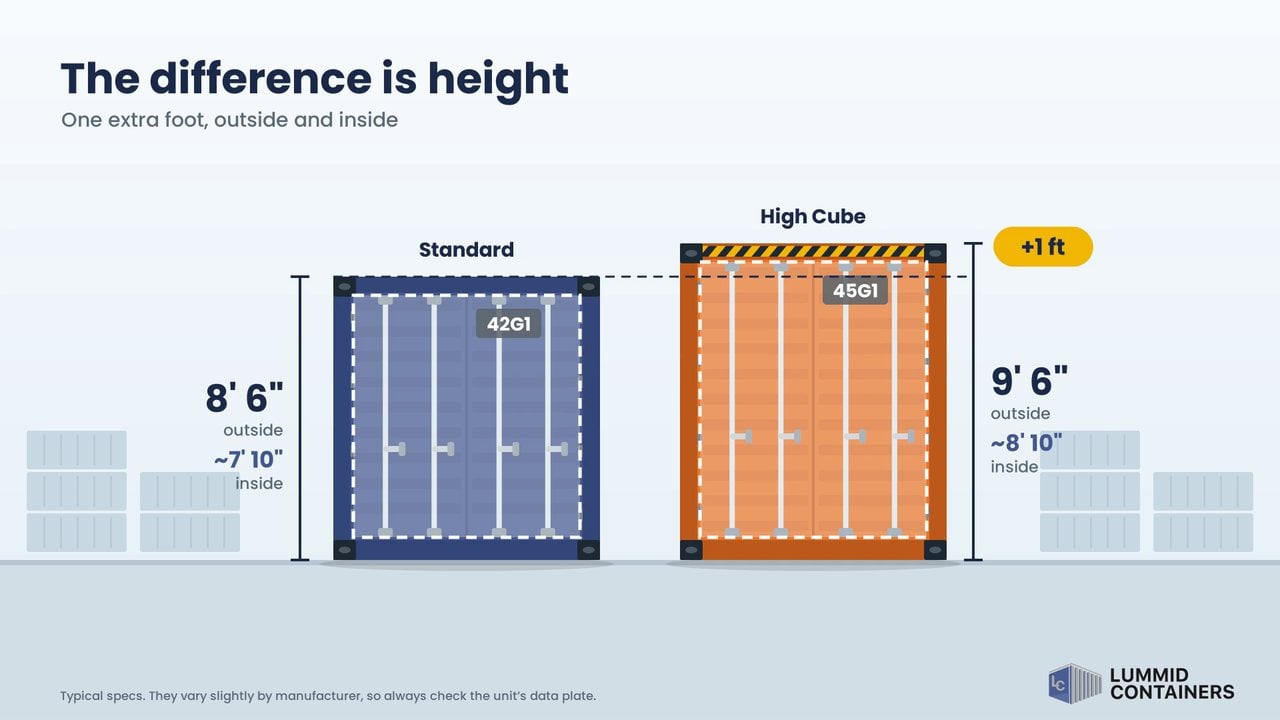
A 40ft standard and a 40ft high cube are the same length and width. The high cube is 1 foot taller: 9’6″ outside instead of 8’6″. That extra foot gives about 13% more space, and the price gap is usually small.
Buying for resale or in volume? Request a wholesale quote or call (888) 471-9099.
Video, 1:29. Full transcript below. Watch on YouTube
40ft standard vs 40ft high cube: specs
| 40ft standard | 40ft high cube | |
|---|---|---|
| Also called | 40STD, 40FT, GP, DC, DV | 40HC, 40HQ |
| Size-type code on the doors | Usually 42G1 | Usually 45G1 |
| Outside (L x W x H) | 40′ x 8′ x 8’6″ | 40′ x 8′ x 9’6″ |
| Inside (L x W x H), about | 39’5″ x 7’8″ x 7’10” | 39’5″ x 7’8″ x 8’10” |
| Door opening | Standard height | About 1 ft taller |
| Inside volume, about | 2,390 cu ft | 2,690 cu ft (about 13% more) |
Names and codes
A 40ft standard goes by many names: 40STD, 40FT, GP (general purpose), DC (dry container) and DV (dry van). They all mean the same box. The high cube is a 40HC or 40HQ. HC and HQ mean the same thing.
On a price list, a plain “40ft” means the standard. If you want the high cube, look for HC or HQ.
The size-type code on the doors tells you too. The first digit is the length: 4 means 40 feet. The second digit is the height: 2 means 8’6″ and 5 means 9’6″. So 42G1 is a standard and 45G1 is a high cube.
The size difference is height
Both boxes are 40 feet long and 8 feet wide on the outside. Inside, both are about 39’5″ long and 7’8″ wide.
The difference is height. A standard is 8’6″ tall outside and about 7’10” inside. A high cube is 9’6″ outside and about 8’10” inside. The door opening is about a foot taller too, so taller items fit through the doors.
About 13% more space
One extra foot of height adds about 300 cubic feet. A high cube holds roughly 2,690 cubic feet. A standard holds roughly 2,390. That is about 13% more space on the same footprint.
Quick way to spot one: many high cubes have yellow and black stripes along the top rail.
What we see in the market
Most shipping lines and leasing companies now run mostly high cube fleets. Ocean freight for a high cube is often priced the same as for a standard, so shippers move more cargo for the same money.
Buyer tip: which one should you buy?
The price gap between a standard and a high cube is usually small. For most buyers, the high cube is the better value: more space for close to the same money.
A standard can still be the right call when height matters, such as a low doorway, an overhang or a height limit on site. It also makes sense for heavy, dense cargo that hits the weight limit long before it fills the box.
Either way, check the data plate on the actual unit and ask which grade you are getting. Our guide to container grades explains one-trip, cargo worthy and wind and watertight.
Questions buyers ask
Is a 40HC the same as a 40HQ?
Yes. HC and HQ both mean high cube: a 40ft container that is 9’6″ tall instead of 8’6″.
What does “40ft” mean on a container price list?
A plain “40ft” means the standard 40ft container, 8’6″ tall. High cubes are listed as 40HC or 40HQ.
How much bigger is a 40ft high cube?
It is 1 foot taller, inside and out, with the same length and width. That adds about 300 cubic feet, or about 13% more space.
Is a 40ft high cube more expensive than a standard?
Usually a little. The price gap is small, so for most buyers the high cube is the better value.
Video transcript
Show the full transcript
40 standard or 40 high cube? Here's the rundown in 90 seconds.
A 40 standard goes by a lot of names. 40STD. 40FT. GP, for general purpose. DC or DV, for dry container or dry van. All of these mean the same thing. The high cube is a 40HC or 40HQ. HC and HQ mean the same thing. On a price list, a plain "40ft" means the standard. If you want the high cube, look for HC or HQ.
Both are 40 feet long and 8 feet wide on the outside. Inside, about 39 feet 5 inches long and 7 feet 8 inches wide. The difference is height. A standard is 8'6" outside, about 7'10" inside. A high cube is 9'6" outside, about 8'10" inside. The door opening is a foot taller too.
That one extra foot gives you about 13% more space. Roughly 2,700 cubic feet versus 2,400. Quick tip. Many high cubes have yellow and black stripes along the top.
Here's what we see in the market. Most shipping lines and leasing companies now run mostly high-cube fleets. Freight is often priced the same, so you ship more cargo for the same money.
Buying one? The price gap is usually small. For most buyers, the high cube is the better value. Need one box or a hundred? Talk to Lummid.
Need one box or a hundred?
Lummid supplies new and used 40ft standard and high cube containers wholesale, from depots across the United States and Canada. See our shipping containers and where we have equipment.
Tell us the size, grade, quantity and delivery ZIP. Request a wholesale quote or call (888) 471-9099. Buying for resale? See wholesale for resellers and bulk buyers.