
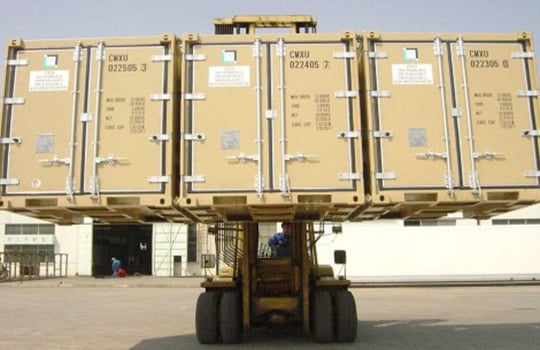
A tricon is a small ISO container built so that three coupled units occupy the footprint of one standard 20ft container. A typical dry-freight tricon measures about 6ft 5.5in long by 8ft wide by 8ft high on the outside, has a maximum gross weight of 14,900 lb, and carries roughly 11,900 lb of cargo at a tare of about 3,000 lb, depending on the build. Coupled sets travel through the intermodal system exactly like a 20ft box, which is why tricons are a workhorse of U.S. military logistics and increasingly common in civilian fleets.
What is a tricon container?
The name is the count: tri means three to a 20ft footprint, alongside the quadcon (four) and the bicon (two). Each tricon is a complete container in its own right, with ISO corner fittings, four-way forklift pockets and its own doors and locks. Manufacturer datasheets for current production units list conformance with ISO 668 and ISO 1496 and CSC certification, with stacking strength specified to nine high; the primary user of the format is the United States Armed Forces.
Tricon dimensions and weights
Figures vary slightly by manufacturer and door configuration. The table shows a representative current-production unit (Sea Box SB825.0, a double-door pattern) with the ranges published by W&K for their tricon line.
| Specification | Sea Box SB825.0 datasheet | W&K tricon line |
|---|---|---|
| External length | 6ft 5 1/2in | 6ft 5 9/16in |
| External width | 8ft 0in | 8ft 0in |
| External height | 8ft 0in | 8ft 0in |
| Internal dimensions | 6ft 4in L x 7ft 6 9/16in W x 7ft 4 15/16in H | 6ft 3in L x 7ft 7 1/2in W x 7ft 5in H, approx. |
| Tare weight | 2,986 lb (1,354 kg) | about 2,600 lb standard, 3,530 lb for the four-door Tricon III |
| Payload | 11,914 lb (5,404 kg) | varies with tare |
| Max gross weight | 14,900 lb (6,758 kg) | 14,900 lb |
| Capacity | 354 cu ft (10.02 cu m) | 356 cu ft; 312 cu ft for Tricon III |
As with any used ISO equipment, treat the data plate on the specific unit as the authority, not a generic table.
Door configurations: Tricon I through V
Because tricons are often coupled into sets, where the doors sit matters more than on a full-size box; a middle unit in a coupled set cannot be opened from the ends. Suppliers commonly label the patterns:
- Tricon I: cargo doors on one end
- Tricon II: doors on each side
- Tricon III: doors on each end and one side
- Tricon IV: doors on each end and each side
- Tricon V: doors on each end
Side-door patterns (II, III, IV) keep every unit accessible even while the set stays coupled, at the cost of some payload and simplicity. End-door patterns maximize cube and strength for units that will be split before unloading.
How the coupling works
Tricons connect with interconnecting couplers that lock adjacent corner fittings together; a typical new unit ships with three couplers. Once three units are joined, the set presents standard 20ft corner castings and is lifted, twist-locked and cell-guided like any 20ft container. Sets can be packed separately, sealed separately, shipped as one, and then broken back into forkliftable units at the destination.
What tricons are used for
The format was driven by military unit deployments: gear moves in the same lockable, stackable steel box that stores it in garrison, and a three-pack rides any container ship, flatcar or chassis. Specialized variants carry the pattern further, from weapons racks and shelving to refrigerated tricons for field feeding. The same properties serve civilian buyers who need secure storage that a standard forklift can reposition: utility and telecom sites, remote camps, construction laydown yards, events, and marine or offshore work.
If you are weighing formats, our tricon vs quadcon vs bicon comparison goes deeper.
What to check before you buy
- Door pattern. Decide whether units must open while coupled; that choice alone narrows you to side-door or end-door variants.
- Data plate. Confirm the plate is present and the ratings match your transport plan.
- Couplers. Confirm they are included if you intend to ship as coupled sets.
- Matching sets. For coupled shipping, buy matched-height, matched-condition units, ideally from one production source.
- Condition grade. One-trip, cargo-worthy and WWT logic applies; see our container grades guide.
Sourcing tricons in quantity
Lummid supplies tricons on a build-to-order basis rather than from stock: units are manufactured to your order in the door configuration you specify (Tricon I through V) and then shipped, so production and transit time needs to be part of your project schedule. If your dates are firm, start the conversation early so the build can be scheduled ahead of when you need the boxes on site.
For military and specialty ISO programs, see our military containers page, or request a wholesale quote with your quantity, door configuration and delivery points.
Sources
- Sea Box SB825.0 tricon data sheet (dimensions, weights, capacity, standards, couplers)
- W&K tricon specifications (door variants I through V, weights and capacities)
- Klinge Corporation, What is a Tricon Shipping Container (three to a 20ft footprint, primary military use)